qq-ai-bot
A production-grade open-source QQ ↔ AI bot scaffold built for self-hosted NapCat / LLOneBot deployments and ACP-compatible local agents. It keeps transport, session orchestration, and agent execution clearly separated so the repo feels more like infrastructure than a one-off chat demo.
A common real-world shape is to put DeepSeek or another local / self-hosted model runtime
behind an ACP-compatible agent, and let qq-ai-bot handle the QQ / OneBot transport,
session reuse, progress streaming, and deployment-facing glue.
If this repo already saved you OneBot / ACP wiring time: the shameless fast path is to tip ¥9.9 / ¥19.9. If you want something concrete back, jump straight to the ¥29.9 quick read or ¥99 async packaging pass for your own bot / agent repo.
Newest install surface: a public CasaOS app-store PR is now open, so the repo is also being packaged as a more homelab-friendly browser-first install path instead of only “clone compose and figure it out”.
Stable release signal: the repo now ships both a stable image tag ghcr.io/happysnaker/qq-ai-bot:v0.1.7 and the moving mainline tag ghcr.io/happysnaker/qq-ai-bot:latest, so directory / app-store / homelab writeups can reference a non-moving version without giving up a newest-build path.
New hardware signal: both public image paths now ship linux/amd64 and linux/arm64, so this stack is no longer only an x86 story — ARM NAS / mini-PC / SBC homelab installs are now part of the real public path too.
Tester ask: QEMU arm64 smoke is green, but a real physical ARM / CasaOS / NAS / SBC report is still missing. Start with the 15-minute ARM / CasaOS tester pack.
Copy/paste pitch if you share this repo: OneBot 11 + ACP + persistent sessions + progress streaming + Docker demo + ARM/CasaOS tester pack.
Live ecosystem signal
- Public OneBot ecosystem placement —
qq-ai-botnow appears in the OneBot ecosystem application cases list instead of living only on its own README - Why that matters — this gives the repo one third-party ecosystem anchor that is native to the QQ / OneBot audience, not just generic AI-awesome lists
- Official OneBot discussion is live — the repo is now also posted in the official OneBot “应用 / SDK” discussions, so people browsing the protocol community itself can discover it without leaving GitHub
- NapCat community thread is live — the repo is now also posted in NapCatQQ Show and tell so operators already in that ecosystem can discover it without leaving GitHub
- NapCat docs integration landed —
qq-ai-botis now also documented in NapCat community resources / integration docs, which is stronger than only having a showcase thread - LLOneBot docs PR is open —
qq-ai-botis now also proposed for the official LLOneBot docs as a framework integration path - Docker Compose sample PR is open — a concrete NapCat + qq-ai-bot sample PR is now proposed to Docker's Compose samples repo, which is a better fit than generic awesome-list spray
- AwesomeHomelab PR is open —
qq-ai-botis now also proposed to AwesomeHomelab, which is a cleaner homelab-facing discovery path than another generic AI list - CasaOS app-store PR is open —
qq-ai-botis now also proposed to CasaOS-AppStore-Play as a NapCat WebUI + bundled bridge stack, which is the cleanest current path toward real homelab installs - Chinese discovery surfaces are live — the repo is now also circulating through public recommendation / weekly threads such as HelloGitHub, GitHubDaily, 阮一峰周刊, 老胡周刊, and developer-plus weekly, so discovery is no longer only GitHub-native protocol communities
- Stable + moving image paths are live — the repo now ships both
ghcr.io/happysnaker/qq-ai-bot:v0.1.7andghcr.io/happysnaker/qq-ai-bot:latest, so self-hosted directories can point to a stable version while operators who want the newest default-branch build still have a moving tag - Multi-arch image is live — both public image paths now expose
linux/amd64andlinux/arm64, with arm64 QEMU smoke automation keeping the homelab / NAS / SBC install story honest while real physical-host reports collect in issue #26 - ACP protocol discussion is live — a protocol-facing question based on
qq-ai-bot's richer-media boundary is now posted in the official ACP discussions - ACP docs listing merged —
qq-ai-botis now included in the official ACP clients documentation under Messaging - Operational honesty — the public deployment matrix now separates “repo-owned stronger paths” from “documented but not overclaimed” paths, which makes the project feel more serious
- Community proof threads — Show and tell and deployment matrix Q&A are open so real deployment reports can accumulate in public
- LLOneBot community thread is live — there is now a matching LLOneBot Show and tell post for the users who operate closer to that stack
- Best short pitch —
OneBot 11 + ACP + persistent sessions + progress streaming + Docker demo
The goal is to make this repo look like a living integration surface with ecosystem references and user feedback loops, not a dead side project.
ARM / CasaOS tester path
The project already has multi-arch GHCR images and passing GitHub Actions QEMU arm64 smoke. The remaining proof gap is a real physical ARM / CasaOS / NAS / SBC report from an operator environment.
- Already proven: `v0.1.7` image, Docker publish, CI, CodeQL, and arm64 QEMU smoke are green.
- Still needed: physical ARM host or CasaOS app-store flow with redacted evidence.
- Good testers: Raspberry Pi, Orange Pi, ARM NAS, CasaOS host, or real `linux/arm64` Docker host.
- Support note: use
qq-ai-bot #26 arm64if you want to fund this validation instead of testing it yourself.
Public-safety rule: do not post QQ credentials, login QR screenshots, OneBot tokens, private group/user IDs, private chat content, or unblurred local/IP details.
Why this repo exists
- keep QQ transport logic independent from any specific model vendor
- reuse an ACP-style local agent bridge instead of hard-wiring one chatbot backend
- preserve session continuity per private chat or group conversation
- stream plan / tool / progress events back into QQ without inventing a custom protocol
- make the repo feel like a real bot infrastructure scaffold, not a fragile demo
- leave room for Telegram / WeChat / Feishu-style channel adapters later
- support local self-hosted agent workflows and operationally cleaner deployments
- give OneBot + ACP users a faster starting point than wiring everything from scratch
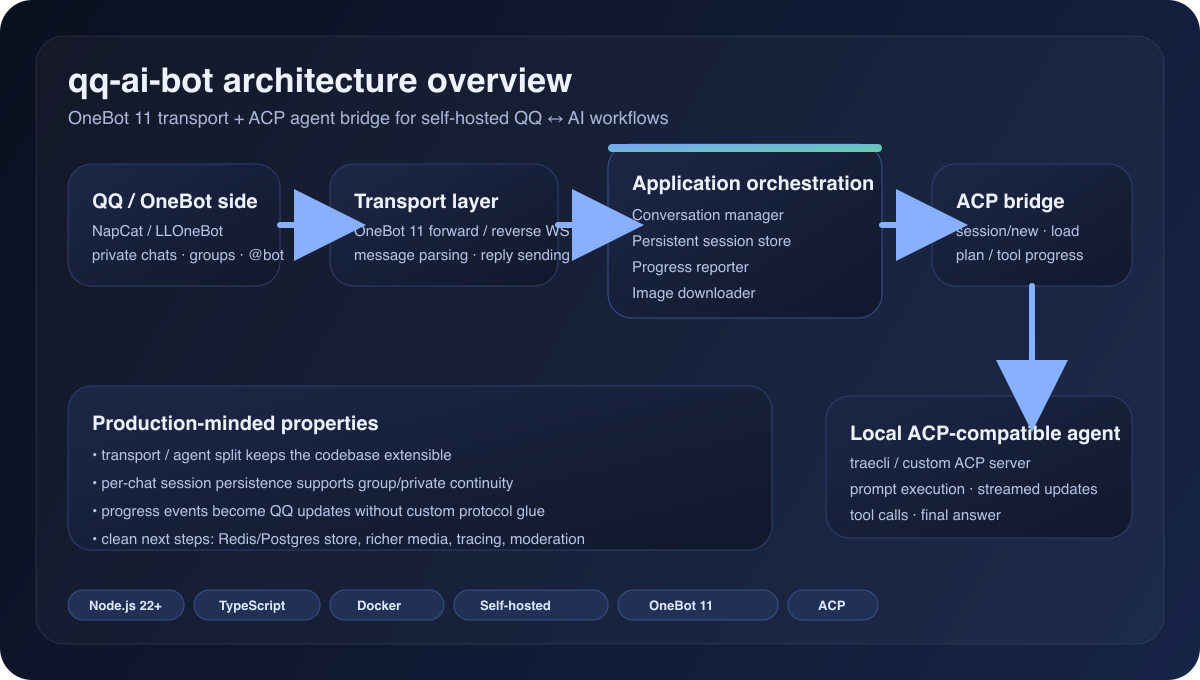
System shape
High-level view of how transport, session orchestration, and ACP execution stay separated.
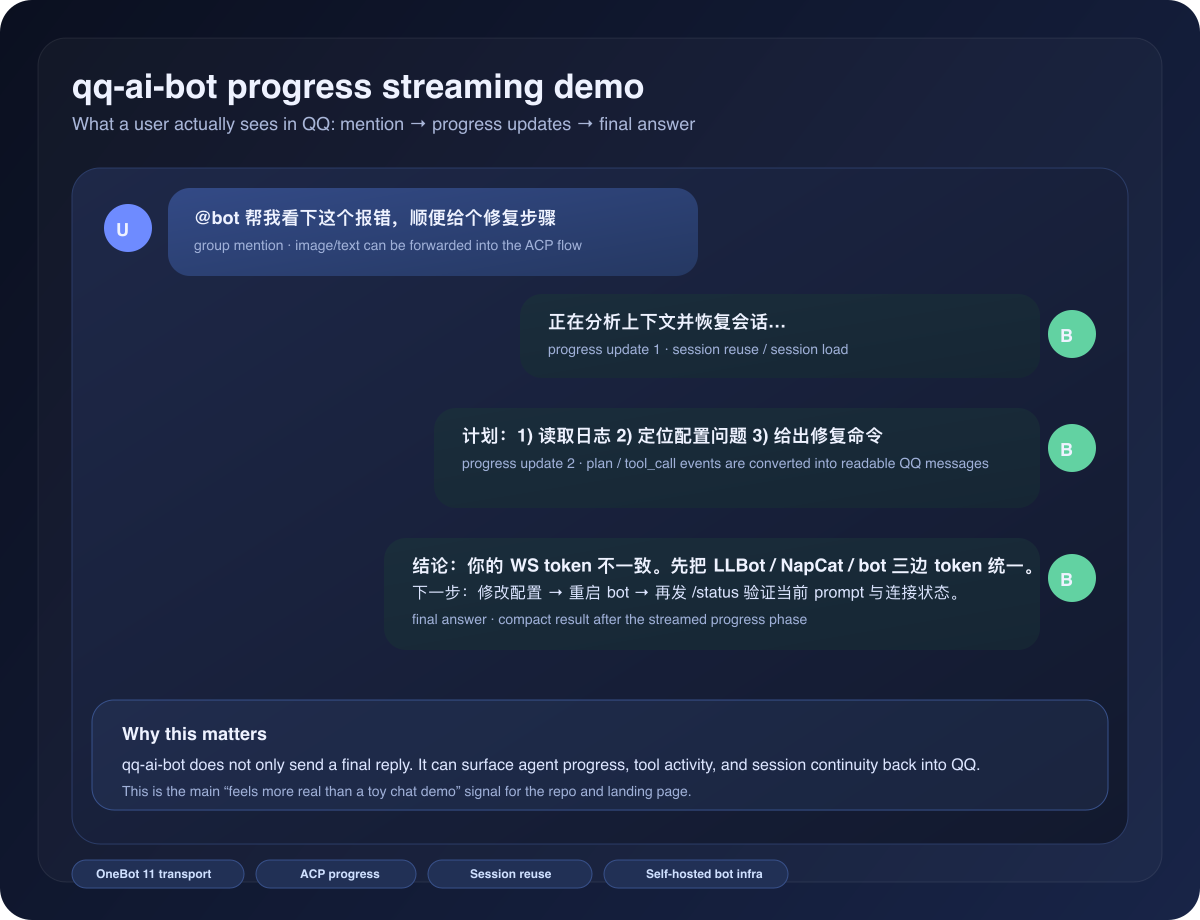
What the user actually sees
A real strength of this repo is that it can stream progress updates back into QQ instead of only dumping a final answer.
Recent updates
- v0.1.0 released — public release with OneBot 11 transport, ACP bridge, Docker demo, and observability surfaces
- v0.1.1 released — patch release that adds lightweight inbound replay dedupe and exposes duplicate-drop metrics
- v0.1.2 released — adds per-interaction correlation IDs across receive / dedupe / ACP dispatch / progress / reply so one noisy turn is easier to trace end to end
- v0.1.3 released — stages richer-media fallback handling so file / audio / video-like attachments are no longer silently ignored before the agent sees any warning
- v0.1.4 released — stabilizes the public Docker image tag for directories and homelab writeups
- v0.1.5 released — adds latency histograms for stronger runtime observability
- v0.1.6 released — adds a Postgres-backed session-store option for longer-running deployments
- v0.1.7 released — adds the public arm64 image-smoke workflow and verifies the tag image through GitHub Actions
- Deployment matrix published — public docs now separate stronger reverse-path defaults from forward-mode / platform combinations that are only documented support
- New FAQ + Discussions flow — common setup mistakes now route through FAQ and Q&A instead of vague issues
- DeepSeek-ready positioning — public docs now explicitly describe the common DeepSeek-backed local-agent deployment path
- Show-and-tell thread is live — community deployments can now collect in one public place instead of being scattered in ad-hoc comments
- Replay guard landed — the bridge now has a lightweight inbound dedupe layer to reduce obvious OneBot replays before they become duplicate ACP calls
- Active ecosystem outreach — now includes merged NapCat and ACP docs integrations, plus still-open Docker Compose and LLOneBot ecosystem PRs
- OneBot ecosystem listed — already included on the public OneBot ecosystem application cases page
- ACP ecosystem listed — already merged into the public awesome-agent-client-protocol list
- NapCat docs integration merged — qq-ai-bot now appears in NapCat community docs and integration guidance
- Docker Compose sample PR opened — a NapCat + qq-ai-bot stack is now proposed to docker/awesome-compose
- LLOneBot docs PR updated — the qq-ai-bot integration guide PR for official LLOneBot docs now also clarifies the LLOneBot forward-WS root-path detail
- ACP protocol discussion posted — a protocol-facing richer-media question is now live in the ACP community
- ACP official docs listing merged —
qq-ai-botis now included on the official ACP clients page - OneBot official discussion posted — live in the official OneBot “应用 / SDK” discussions
- NapCat show-and-tell thread posted — live in NapCatQQ discussions
- LLOneBot show-and-tell thread posted — live in LLOneBot discussions
- AwesomeHomelab PR opened — a homelab-facing listing PR is now open so discovery is not limited to protocol-native communities
- Three claimable issues are public — latency histograms, Postgres session store, and multi-instance deployment notes are now open instead of leaving the repo looking announcement-only
- New self-hosted AI listing live — now proposed to an actively maintained AI agents ecosystem list under Self-Hosted Agents and UIs
- Best short pitch —
OneBot 11 + ACP + persistent sessions + progress streaming + Docker demo - Latest engineering signal — unsupported richer media is now surfaced explicitly to the agent instead of being silently dropped, which is a small but real runtime hardening step
- Latest operations signal — deployment paths now have a public confidence matrix instead of one vague “supports NapCat / LLOneBot” claim
- Support path stays simple — if this repo saved you time, ¥9.9 / ¥19.9 is still the lowest-friction thank-you path
This page is maintained as a live project-facing landing page rather than a one-time README mirror.
Why this repo looks worth betting on
- released as v0.1.0 with CI, Docker publishing, and build metadata now exposed in status endpoints
- v0.1.1 adds a replay-dedupe guard and makes duplicate-drop behavior visible in metrics
- v0.1.2 adds per-interaction correlation IDs so operators can grep one user turn across receive, dedupe, progress, and reply logs
- v0.1.3 makes richer-media limitations honest in runtime behavior by surfacing unsupported file / audio / video segments to the prompt layer
- v0.1.5 adds latency histograms, v0.1.6 adds Postgres session storage, and v0.1.7 adds public arm64 image-smoke evidence
- deployment-matrix.md now says explicitly which routes are stronger repo-owned paths and which are only documented compatibility paths
- richer-media stage 1 now makes the repo safer to demo because unsupported attachments no longer create the illusion that the agent already consumed them
- /metrics now exposes Prometheus-style runtime counters for connection state, traffic, ACP calls, and conversation gauges
- has a public roadmap instead of pretending the current shape is the final shape
- actively invites contributions on session storage, richer media, and stronger runtime visibility
- better than a throwaway demo: it already has architecture notes, quickstart docs, and health endpoints
- best next high-signal OSS work here is Redis session store, richer media, and tracing / deeper observability
- if you want your own bot repo packaged this clearly, the blunt paid read starts at ¥29.9
Useful links: roadmap · contributing · help wanted issues
What you get today
- OneBot 11 reverse and forward WebSocket modes
- private chat + group mention triggers
- persistent conversation sessions keyed by QQ conversation
- image download and pass-through into the ACP agent flow
- progress message streaming from plan / tool events
- health and readiness endpoints
- mock ACP agent for local integration work
- ESLint, typecheck, tests, and GitHub Actions
- Docker packaging for cleaner deployment
- clear extension path for richer media and stronger observability
Quick start
- Clone the repo and install dependencies with
npm install. - Copy
.env.exampleto.env. - Start with the mock ACP agent first to validate the bridge path.
- Point NapCat / LLOneBot at the reverse WebSocket endpoint and run
npm run dev.
Full config examples, deployment details, and the session / progress model live in the repository README and architecture doc.
Who this is for
- engineers building self-hosted QQ bot infrastructure
- developers experimenting with ACP-compatible local coding / chat agents
- people who want a better starting point than mixing transport code and model code together
- maintainers who want a clearer architecture before adding Redis, tracing, or moderation logic
- hackers exploring multi-channel bot infrastructure after starting from QQ / OneBot
- anyone who wants a modern repo that feels more like middleware / orchestration than a toy bot
Support
If qq-ai-bot saved you OneBot + ACP plumbing time, the cleanest support path is a small direct tip
or support via the support page. Best payment note: qq-ai-bot.
- ¥9.9 / ¥19.9 — thank-you tip if this repo saved you setup or wiring time
- Best payment note —
qq-ai-botorqq-ai-bot setup - Fastest path — scan WeChat Pay / Alipay on the support page
- ¥29.9 deploy read — best if your bot technically runs but the token / WS / Docker / landing-page story is still muddy
- ¥29.9 quick read — one blunt paragraph + top 3 fixes for your own bot / README / landing page
- ¥99 async review — GitHub profile, pinned repos, README cleanup, or one focused landing page
- Public intake guardrail — do not paste private logs, credentials, QR codes, payment screenshots, internal URLs, or raw live integration output in public issues; use sponsor / paid-support intake replies first
- Route by audience — use the sponsor prospect pipeline to choose the right proof, CTA, support note, and guardrail for homelab testers, bot builders, curators, sponsors, and paid-review customers; then use the sponsor conversion scorecard to decide Hot / Warm / Nurture / No-send before posting
- Best fit — if you want your own AI / infra repo to feel less toy-like and more hireable
If you want broader GitHub / README packaging feedback for your own bot, agent, or infrastructure repo, the lightweight async review options are on the review page.
Best use of the ¥29.9 path: “I already have a bot repo, but it still looks toy-like / messy / too student-ish.” That is the highest-conversion case for this page.
Best use of deploy read: “The repo technically runs, but the deploy story still feels janky: token mismatches, reverse WS confusion, Docker layout, and project-page credibility are all half-solved.”
If you want to preview the tone first: open the deploy-read sample before buying.
Best email subject if you came from this page: Quick read | qq-ai-bot inbound | repo link or Async review | qq-ai-bot inbound | repo link.
If payment evidence is needed: keep payment screenshots out of public issues; move them to email / private chat and keep the public thread on repo links, proof links, and support notes.
Typical turnaround: the ¥99 async-review path is usually answered within 72 hours, often faster for simple README / landing-page passes.
Copy/paste promo pack
If you want to share qq-ai-bot in a QQ / OneBot group, submit it to a weekly newsletter,
or send it to a friend without rewriting the pitch every time, copy one of these.
Shortest line
OneBot 11 + ACP + persistent sessions + progress streaming + Docker demo
Chinese version
qq-ai-bot 是一个面向 OneBot 11 / NapCat / LLOneBot 的 QQ ↔ AI 自托管脚手架。它把 QQ 消息入口、ACP agent bridge、会话持久化、进度回传和 Docker demo 整理成了一个更像 bot 基础设施的仓库,而不是只会聊天的玩具 demo。
English version
qq-ai-bot is a self-hosted QQ ↔ AI bot scaffold for OneBot 11 / NapCat / LLOneBot and ACP-compatible agents, with persistent sessions, progress streaming, and a Docker demo. It is positioned as bot infrastructure / integration glue rather than another toy chat UI.
Homelab / CasaOS tester ask
Need one real ARM/CasaOS tester for qq-ai-bot.

CI/QEMU arm64 smoke is green, but I still need a physical ARM/NAS/SBC/CasaOS report.

Tester pack:
https://github.com/happysnaker/qq-ai-bot/blob/main/docs/public/arm64-casaos-tester-pack.md

Outreach kit:
https://github.com/happysnaker/qq-ai-bot/blob/main/docs/public/homelab-outreach-kit.md
Best 3-link pack
Repo: https://github.com/happysnaker/qq-ai-bot
Project page: https://happysnaker.github.io/qq-ai-bot/
Outreach kit: https://github.com/happysnaker/qq-ai-bot/blob/main/docs/public/homelab-outreach-kit.md
Best framing for maintainers / curators: call it a QQ / OneBot bridge, bot scaffold, or self-hosted bot infrastructure project. Do not flatten it into “just another chatbot”. If posting to homelab/CasaOS communities, lead with the tester ask and keep the QEMU-vs-physical-host caveat explicit.
Fast curator update line after tester pack: Now ships stable + latest multi-arch images, passing arm64 QEMU smoke, and a 15-minute ARM/CasaOS tester pack for real physical-host reports.
Tip in 10 seconds
If this repo already saved you an hour of wiring, debugging, or README archaeology, do not overthink it.
Scan one of these, leave qq-ai-bot or qq-ai-bot setup as the note, and you're done.
If you are not sure whether to tip, inspect proof, buy a deploy-read, or fund qq-ai-bot #26 arm64, use the 10-second support router first.
If you want something concrete back, use the ¥29.9 quick read or
¥99 async review path instead.
Fastest path for a direct ¥9.9 / ¥19.9 thank-you tip if qq-ai-bot saved you setup time.

Same shortest path. Best payment note: qq-ai-bot, qq-ai-bot setup, or bot repo read.

Roadmap tie-in: direct support helps keep work moving on physical ARM/CasaOS validation, Redis session storage, richer media, tracing, and the next production-grade polish round.
Fastest homelab inbound path: if you came from CasaOS, Docker, AwesomeHomelab, or a self-hosted roundup, start with the tester pack; the best support note is qq-ai-bot #26 arm64.
Public issue privacy rule: no private logs, credentials, QR codes, payment screenshots, internal URLs, or raw live integration output in public issues.
Low-friction promo ask: if you share this repo in a QQ / OneBot / self-hosted AI group, the most useful link is the project page plus the note OneBot 11 + ACP + /metrics + Docker demo.
Best 3-link promo pack: repository + project page + Docker quickstart.
July offer: the first paid request this month gets one extra public page / README in the same async pass.